A concealed-coil notebook can look like a clean fabric-covered book from the outside while the buyer is still deciding how the metal coil should be hidden and how the cover should open. That decision affects page movement, cover alignment, closure details, logo position and unit packing. For a Beauty GWP program, the buyer should approve the complete physical sample route rather than approve the cover image alone.
Use the Ecorivta custom sewn notebooks page 1 for the commercial product route. This article has a narrower job: it explains concealed-coil notebook sample approval when the buyer wants a metal-coil notebook without an exposed coil.
Quick Buyer Summary
- Decide first whether the notebook is coil-bound or thread-sewn; the outside cover should not be used to infer the inside binding.
- If the metal coil must be concealed, compare physical routes for cover opening, page movement, edge alignment and assembly.
- Freeze the approved route in writing after the buyer selects it. Do not rely on a closed-cover photograph later.
- Approve the debossed logo, strap or closure, ribbon, paper record and individual pack together with the binding route.
- State page count carefully: “100 pages” and “100 sheets” are not interchangeable.
- A sample route that works for one A5 project is not a universal notebook construction standard.
Send a Concealed-Coil Notebook RFQ
Start With the Binding Decision, Not the Cover Photo
“Fabric-covered notebook” describes the visible surface. It does not tell the supplier whether the pages are thread-sewn, metal-coil bound, glued or held by another mechanism. A buyer can approve the suede color and logo position while the most important construction decision remains unresolved.
For concealed-coil notebook sample approval, put the binding choice at the top of the brief:
| Decision field | What the buyer should state | Why it matters |
|---|---|---|
| Binding family | Metal coil, thread-sewn or another approved route. | Changes opening behavior, page movement and internal construction. |
| Coil visibility | Exposed, partly concealed or concealed from normal outside view. | Changes cover structure and assembly. |
| Opening expectation | How far the cover and pages should open in normal use. | Prevents a visually clean cover from restricting use. |
| Approval evidence | Physical sample, dated photos and a signed specification note. | Keeps the selected route traceable before bulk. |
The broader notebook cover, insert and packing brief 2 helps buyers define cover material, paper, branding and packout. Use that guide for the complete brief and use this concealed-coil checklist for the binding approval decision.
Two Concealed-Coil Sample Routes From a Real Project
An anonymous completed order for a Russian beauty brand involved 5,000 A5 gift notebooks. The archived record lists a suede cover, 80 gsm paper, 100 pages, a debossed logo, a ribbon and an individual polybag.
The buyer requested a metal-coil notebook without an exposed coil. During sampling, two structures were prepared for comparison:
- a spring-clip concealed metal-coil route;
- a plastic-snap concealed metal-coil route.
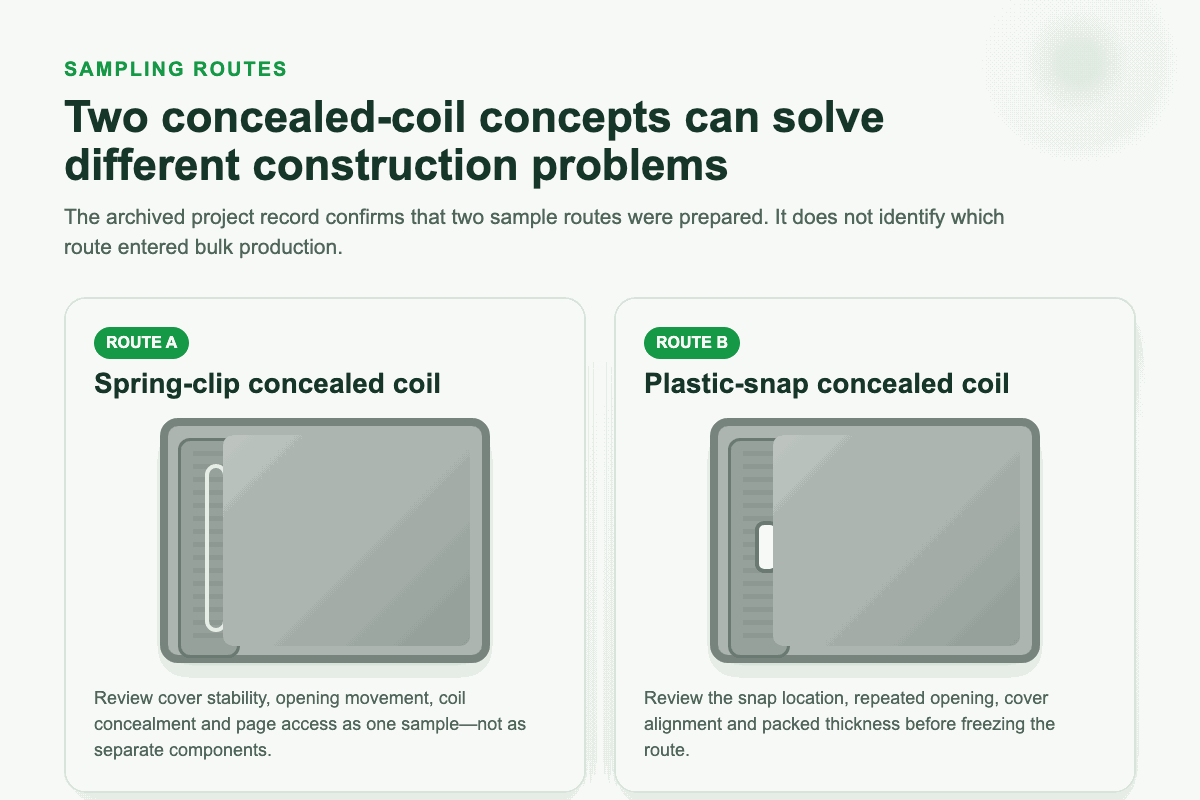
This distinction is important. The project is verified as a completed 5,000-piece order, and the two sample routes are verified. The available record does not say which route the buyer selected for bulk. Ecorivta therefore does not present either mechanism as the final bulk construction and does not mix the two samples into one invented route.
The buyer lesson is not that one mechanism is always better. It is that “conceal the coil” must be translated into a physical sample decision with an accepted mechanism recorded before production.
What to Compare on the Two Samples
The approval should cover use and assembly, not only appearance.
1. Cover opening and page movement
Open the notebook through the expected use range. Check whether the pages turn freely and whether the concealed structure pulls the front or back cover out of alignment. If a buyer needs the notebook to lie flat or fold back, write that requirement before sampling instead of assuming every coil route behaves the same.
2. Coil concealment from normal viewing angles
Review the closed notebook, the opening edge, the spine area and the inside transition. “Not exposed” should be defined through the buyer’s accepted sample photographs. It should not be treated as a universal technical term with one automatic structure.
3. Edge alignment and closure behavior
Check whether the cover edges remain aligned when the notebook is closed. If the design uses a strap, snap, elastic or another closure, review how it sits when the pages are new and after normal sample handling.
4. Assembly and replaceable components
Ask which parts are fixed, clipped or snapped into place. The buyer should understand the route being approved and whether any visible gap or movement is an intended feature of that sample.
5. Packout condition
Place the approved notebook in its intended unit pack. A polybag, belly band, sleeve or gift-set insert can press on the closure or alter presentation. Approve the notebook and the real pack route together.
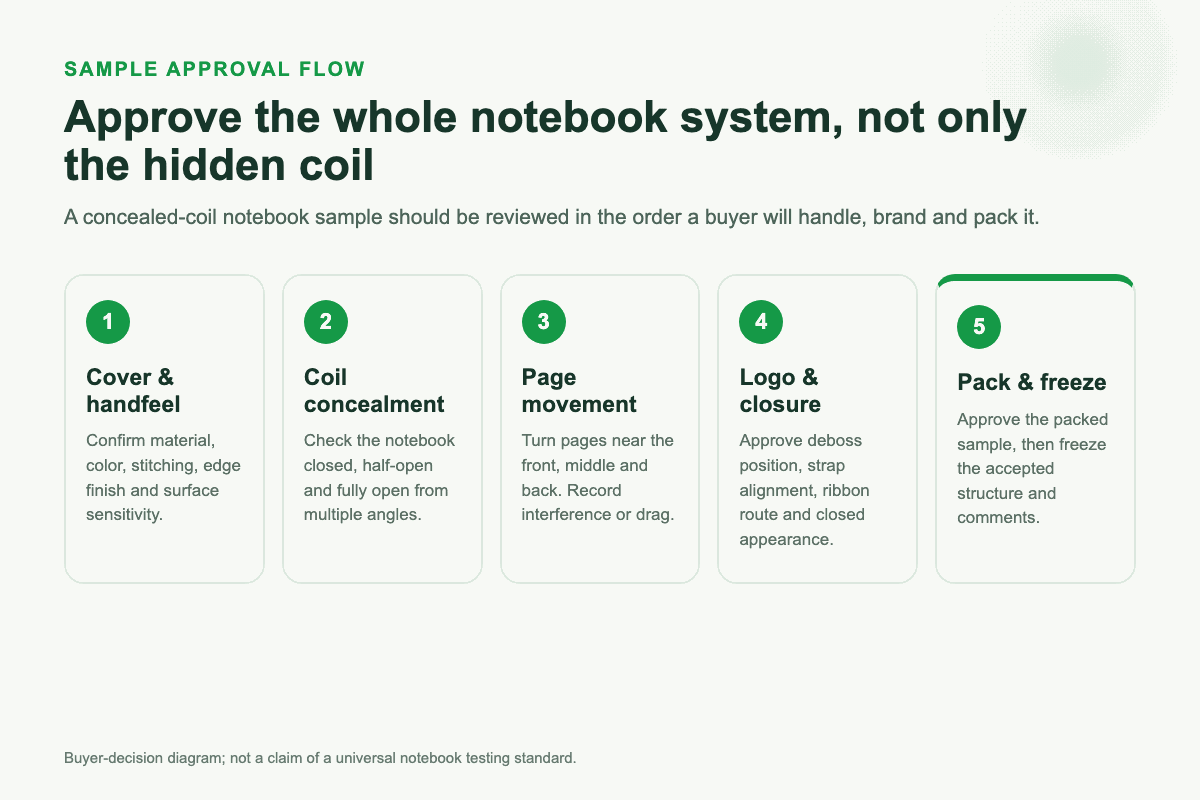
Review Two Notebook Sample Routes
Freeze the Accepted Route Before Bulk
After the buyer selects a sample, convert the decision into a short approval record. It should identify:
- the approved sample version or date;
- the binding family and concealment route;
- A5 or other finished size;
- cover material and approved color;
- paper color, paper weight and whether the count is pages or sheets;
- logo method, artwork size and position;
- ribbon, pen loop, strap, snap, elastic or other accessories;
- individual pack and any belly-band or gift-set insert;
- approved photographs of the opening, spine, inside structure and closed cover.
The approved record should use the buyer’s actual terminology but remove ambiguity. For example, “100 pages” should stay “100 pages” unless the buyer and supplier deliberately agree to change it to a sheet count. Quietly converting the term can double or halve the expected writing surfaces.
If the buyer supplies a physical reference sample, photographs are still useful. Photograph the approved opening behavior and concealed area, not only the front cover. If the buyer supplies a technical drawing, mark the sample version that matches it.
For a faster handoff, send the physical sample details and opening photographs by WhatsApp together with the written RFQ. The final approval should still be kept in the project record.
Logo, Paper and Packing Still Need Separate Approval
A concealed binding does not remove the other notebook risks.
For a debossed logo on suede or suede-style material, review depth, clarity, placement and how the surface responds around the mark. A small logo that reads well on a smooth material may need a different size or pressure on a soft-nap cover. The archived project required a logo-size correction during sampling; that is evidence for checking size on the real cover, not a promise that every debossed logo needs the same setting.
For paper, approve color, weight and count language. The project record lists 80 gsm and 100 pages, but those values are project facts, not default specifications for every Beauty GWP notebook.
For packing, confirm whether the notebook is a standalone gift, part of a launch kit or packed with other beauty accessories. Individual polybagging was the recorded route for this project. A retail sleeve, belly band, gift box or insert would require a different approval.
RFQ Fields That Prevent a Vague Sample
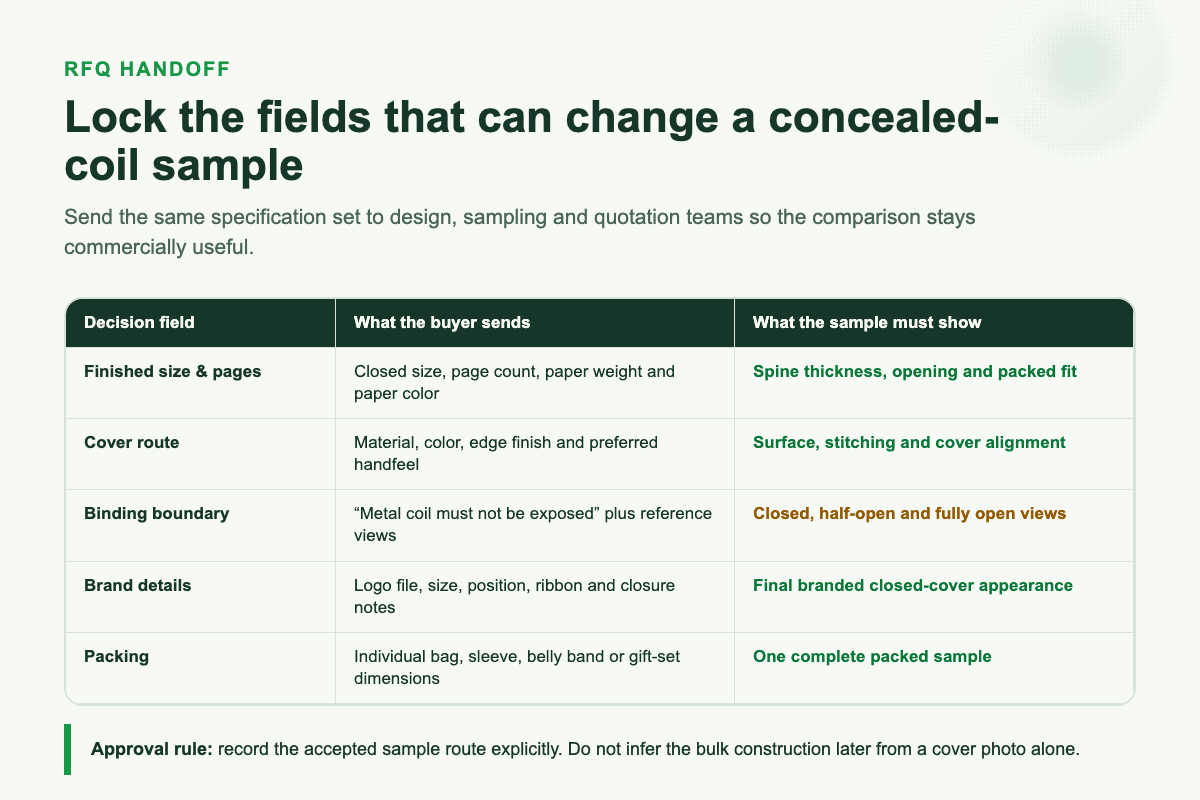
Send these fields before sampling:
| RFQ group | Buyer input | Sample evidence |
|---|---|---|
| Use and quantity | GWP, launch kit, gift set or retail accessory; quantity range and delivery market. | Construction and pack route appropriate to the program. |
| Binding | Metal coil or thread-sewn; concealment expectation; opening behavior. | Inside, spine, opening and page-turn photographs. |
| Cover | Finished size, material, color and handfeel direction. | Physical cover swatch or complete sample. |
| Paper | Color, gsm and pages-versus-sheets definition. | Approved paper sample and count record. |
| Branding | Logo file, method, size and position. | Logo on the actual approved cover material. |
| Accessories and pack | Ribbon, pen loop, closure, belly band, sleeve, box or polybag. | Complete packed sample, not loose parts only. |
Claim Boundaries for This Case
This case supports only the recorded project facts and sampling lesson. It does not establish a universal concealed-coil mechanism, universal A5 specification, fixed MOQ, fixed lead time, test result, certification, shipment result, sell-through or reorder. The featured image is a confidentiality-edited derivative of the archived order photograph; identifying artwork was replaced with ECORIVTA. It is not an unedited original.
FAQ
Is a concealed-coil notebook the same as a thread-sewn notebook?
No. The outside cover may look similar, but the internal binding and opening behavior are different. State the binding family in the RFQ.
Can Ecorivta prepare more than one concealed-coil sample route?
Where the structure and project scope allow, alternative sample routes can be compared. The buyer should approve one physical route and record it before bulk.
Does “100 pages” mean 100 sheets?
Not automatically. Page and sheet counts must be defined in the specification. Do not convert one term into the other without written confirmation.
What photos should be included in notebook sample approval?
Include the closed cover, opening edge, spine, concealed binding area, page movement, logo, closure, accessories and the final unit pack.
Does this 5,000-piece case prove which concealed-coil route was used in bulk?
No. The completed order and two sampling routes are verified, but the available record does not identify the final bulk mechanism.
Send a Notebook Binding and Packout Brief
Send the target size, binding family, coil-visibility requirement, page specification, cover material, logo, accessories, packing route, quantity and delivery market. If the concealment structure is undecided, ask for clearly labeled sample alternatives and approve one route in writing.
Send Notebook Binding and Packout Brief
-
Ecorivta Custom Sewn Notebooks – Used as the query-owner product page for materials, branding, sampling and bulk RFQ scope. ↩︎
-
Custom Sewn Notebook Cover, Insert and Packing Brief – Used for the wider cover, paper, branding and packout brief; it does not own the concealed-coil sampling task. ↩︎