Choosing banana clips vs claw clips for haircare gift-with-purchase (GWP) sets starts with the hairstyle the gift is meant to help someone create. Alongside the campaign colour, the buyer needs to establish whether the clip will hold the intended section of hair, feel straightforward to use and fit the final gift box.
For brand procurement and product-development teams, the useful first decision is the clip structure. Choose the intended use, compare suitable candidates from both families, and then develop the selected style’s material, logo and packaging. This guide helps teams choose an accessory for branded gifts and retail haircare sets.
Quick Buyer Summary
- A banana clip can be considered for a gathered style with the hair hanging down; a claw clip offers a different holding action for a selected section or a twisted-up style. The exact design determines what is feasible.
- Compare candidates for the same intended user and hairstyle. “Large” and “suitable for thick hair” are not equivalent specifications across clip families.
- Use the actual samples to compare hold, handling and comfort for the intended users.
- Choose two clip styles only when they add distinct uses to the set. Otherwise, one well-chosen style keeps the buyer’s brief and the recipient’s choice clearer.
- Check the selected clip inside the proposed gift pack before finalising the set. Measure the packed product; do not infer box depth from a front-view photograph.
Discuss the clip choice for your haircare set
Define the job before choosing the clip
Write one sentence describing the accessory’s role in your haircare GWP set: “The recipient should be able to use this clip to create this hairstyle.” Attach a front and side reference where possible. A photograph of the finished style is more useful at this stage than a colour swatch alone.
Distinguish a gathered ponytail with the length hanging down from a twisted-up style, a half-up section or a temporary sectioning task. These are different briefs. A full-hair sample should not be approved from a demonstration that only gathers a small section.
Describe the intended audience without making a universal-fit promise. Hair length, density, texture and the amount being gathered all affect the review. If the campaign has a broad audience, identify the important use groups and the limitations the brand is prepared to accept.
Compare the holding action, not just the outline
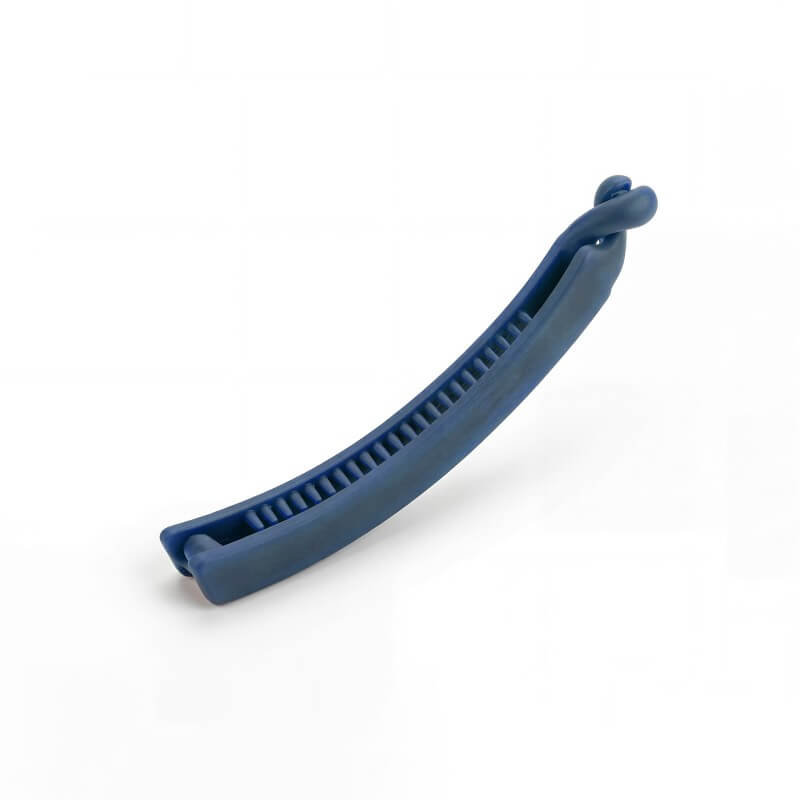
A typical banana clip uses an elongated pair of toothed sides that close around a gathered section, often with a hinge at one end and a fastening at the other. A typical claw clip opens opposing jaws using a spring mechanism. There are variations within both families, so a product name is only the starting point.
| Selection question | Banana clip candidate | Claw clip candidate |
|---|---|---|
| What should happen to the hair? | Consider it when the brief calls for an elongated gathered shape with the hair length hanging down. | Consider it when the selected jaws can capture the required section or hold the intended twisted-up shape. |
| How does the user operate it? | Check how the sides open, how the fastening closes around the gathered hair, and how it is released. | Check how the user squeezes the handles, opens the jaws, positions the hair and releases the grip. |
| What does a useful size comparison show? | The usable toothed length, space inside the closed clip and the fastening arrangement. | The usable jaw opening, space inside the closed clip and the relationship between teeth and handles. |
| What needs checking in a gift box? | The selected clip’s full length, fastening protection and how it is secured without bending it. | The selected clip’s height, projecting handles and how it is secured without loading the spring or teeth. |
Use Ecorivta’s banana clip route page 1 and claw clip route page 2 to identify candidates for discussion. Their style examples are a starting point for the brief; confirm the selected design against its intended use.
Let the same use brief decide between candidates

For haircare GWP sets, the question is not whether a sample can be made to look good once. It is whether the selected structure delivers the use the brand intends. Compare candidate clips with the same target hairstyle and, where practical, the same participants from the intended user groups.
Give each participant the same reference and simple instructions. Record what happens: whether they can create the intended shape, whether they need help or repeated repositioning, whether the hold changes during the agreed use period, and whether they can remove the clip without difficulty. Note the sample reference and the hair/use conditions alongside the observation.
Set the use period and selection criteria before comparing the samples, and record which user groups are represented. If neither candidate completes the intended hairstyle satisfactorily, change the candidates or narrow the intended use before developing the final sample.
A useful comparison record has four columns: intended use, banana candidate observation, claw candidate observation, and selection decision. Keep comments factual—for example, “needed two attempts to close this sample around the intended section”—rather than assigning an unsupported performance score.
Once a claw clip has been selected, use the existing claw clip sample approval guide for its spring, teeth and finish checks. Those checks refine a chosen product; they do not replace the earlier choice between clip structures.
Send your hairstyle references and candidate clips
Share your hairstyle and candidate photos on WhatsApp.
One style or two: does the second clip add a real use?
A mixed banana-and-claw set needs a reason beyond showing two shapes. It may be worth developing when the two selected products serve distinct hairstyles and the brand can explain that difference clearly. If both products are being positioned for the same task, compare them first and consider selecting the stronger fit for that brief.
For a one-style haircare GWP set, confirm which use the brand is prioritising and which limitations need to be communicated. For a two-style set, define the role of each clip, the number of each per gift, and whether the same combination goes into every pack or separate variants are required.
Ask for the one-style and two-style options to be quoted against their actual specifications. A second style changes the item count, quantities by design, packing layout and approval work. The cost difference cannot be derived from the total campaign quantity alone; minimums and feasibility need confirmation for the selected designs.
Check the choice inside the actual gift pack

Place the candidate clip next to the intended haircare products using actual items or accurate packaging mock-ups. Review the closed clip’s occupied space, its display direction, how it is retained, and whether it presses against bottles, cards or the lid. Confirm who supplies the clip, outer pack and any insert, and who approves the assembled reference.
Do not assume that a banana clip is always flatter or a claw clip is always bulkier. Compare the specific samples in the orientation in which they will be supplied. A design that fits loose in an empty box may need more room once its card, fixing or protective packing is added.
For haircare GWP sets, also consider how the recipient discovers the intended use. If the selected structure needs an opening or fastening explanation, allow space for a short instruction or a clearly identified link. Final copy and artwork should be checked against the approved sample.
Questions that come up before selection
Is a banana clip better than a claw clip for thick hair?
The category name does not establish that. Compare the usable capacity, fastening or jaw arrangement, intended hairstyle and observed sample behaviour. A result for one large design should not be applied to every clip in that family.
Can the same nominal size be used for both clip types?
It can describe an external dimension, but it is not enough for a functional comparison. Request the relevant open and closed dimensions and inspect where the intended section of hair sits.
Should a mixed set contain one banana clip and one claw clip?
Only if the combination supports the program’s use brief. Specify the job of each clip and compare the assembled pack and quote with the one-style option before committing to the combination.
Can we confirm materials and branding after choosing the structure?
Use the initial structure comparison to narrow the choice, then confirm the exact material, construction, finish and branding on the selected sample. Changes can affect the result, so approval should refer to a clearly identified final specification.
Send a selection brief for your haircare GWP set
To compare banana clips vs claw clips for a haircare GWP set, send the intended hairstyle references, target user groups, candidate product references and the role of the accessory in the campaign. Include the quantity by design and colour, delivery market, required arrival date, available gift-box layout and whether you want one style or a mixed set.
Mark the decisions still open. Ecorivta can review the proposed product routes and confirm availability, minimum quantities, customisation, timing and the sample plan against the selected designs.
Request a clip selection and set-layout review
Send your gift-box layout and clip-set brief on WhatsApp.
About the author: Lina Lv, Sales Manager at Ecorivta, works with brand buyers on beauty GWP and accessory project briefs. Connect with Lina.
Cover image: AI-generated illustration of the two clip structures.
Product references used in this guide
Ecorivta banana clips and ponytail holders — Product-family and style references. ↩︎
Ecorivta claw clips — Product-family and style references. ↩︎

对比丝印托特包的写实概念海报图;海报上的文字为:-Screen-Printing-vs.-Embroidery_-Which-Branding-Method-Suits-Custom-Canvas-Tote-Bags-300x168.jpg)