Cover: AI-generated concept illustration, not a product test or an available style.
When a Beauty GWP buyer asks for travel pouches that are “easy to clean,” the phrase is not yet a specification. It may mean that makeup residue can be removed with a damp cloth, that the complete pouch can be washed, that the lining resists short contact with water, or that a bottle leak should remain inside the bag. Those are different jobs.
The useful procurement step is to turn the intended use into an agreed sample review. Define the substance, contact time, cleaning method, drying method, areas to inspect and wording the brand hopes to print. Then review the complete construction—not only a fabric swatch—before approving a care or liquid-barrier claim.
Quick buyer summary
- Wipe-clean describes a cleaning action. Name the likely residue, wiping material and acceptable result.
- Washable needs a complete care route for the finished pouch, including water temperature, cycle or hand-wash method, detergent, drying and number of review cycles.
- Water-resistant and leakproof are not interchangeable. A fabric surface test does not establish that a sewn bag will contain liquid.
- Review shell, lining, seams, zipper, binding, decoration and hardware after the agreed exposure or cleaning method.
- Freeze the sample revision, review record and approved wording together. A later material, coating, seam or decoration change can trigger another review.
Review a travel pouch cleaning brief
Start with the incident the pouch must handle
Write the use case before selecting a claim. Is the pouch supplied empty as a gift, packed with sealed minis, or shipped as a filled travel set? Is the concern loose powder and foundation residue, a damp bathroom surface, a short splash, or liquid escaping from a container? The answer changes both the construction and the review method.
A useful first sentence is specific: “The recipient should be able to remove a small amount of the nominated foundation from the lining with the agreed damp cloth without remaining visible staining or surface damage after drying.” The project team still needs to agree the amount, contact period, cloth, cleaning agent, number of cycles and visual acceptance conditions. The sentence does not assume the outcome.
For a filled Beauty GWP set, record the exact bottles, caps and orientations used in the packed sample. The pouch can be one control in the packout, but it should not be treated as a substitute for suitable primary packaging and closure checks.
Keep four different claims separate

The terms below answer different questions. Choose only the claim that matches the intended use and the evidence the project will create.
On a small screen, swipe the comparison table sideways to read all three columns.
| Requested wording | What the buyer should define | What it does not establish by itself |
|---|---|---|
| Wipe-clean | Residue or substance, amount, contact time, wiping material, cleaning liquid, number of passes, drying and acceptable appearance. | Machine washability, resistance to every cosmetic formula, or containment of a bottle leak. |
| Washable | Hand or machine route, temperature, cycle, detergent, load, drying, number of cycles and limits for shrinkage, colour, shape, coating and hardware. | That every component can tolerate the same route, or that a swatch result applies to the sewn pouch. |
| Water-resistant | The surface or assembly being assessed, exposure method, duration, acceptance measure and whether the result concerns wetting or penetration. | Leak containment. ISO 4920, for example, measures resistance of fabric to surface wetting and states that it does not predict rain penetration. |
| Leakproof | Liquid, volume, orientation, duration, closure position, pressure or movement, seam route and the allowed result for the finished bag. | That a coated lining automatically seals needle holes, zipper gaps, corners or binding joins. |
ISO 4920 explains the boundary of a fabric surface-wetting test 1. It is a useful reminder that the method must match the claim. If the project requires finished-bag containment, agree a finished-bag method rather than borrowing a fabric result.
Review the whole construction, not just the lining name
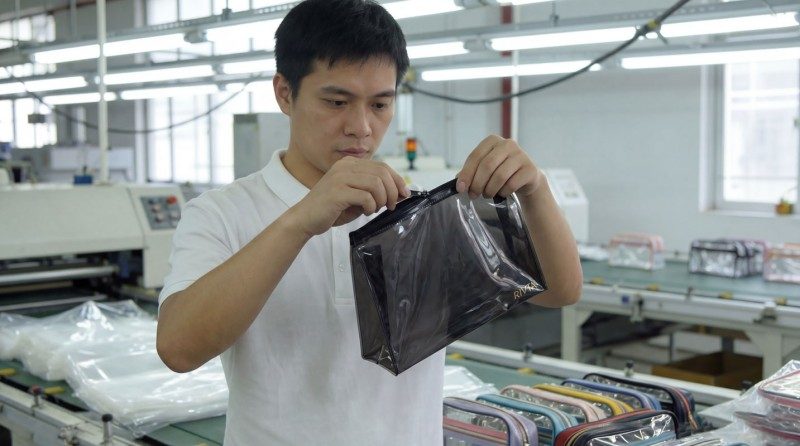
A wipeable film, coated fabric or smooth lining may simplify one cleaning route, but the finished pouch may also include stitching, binding, zipper tape, pullers, reinforcement, printing, labels and adhesives. Residue may collect at seams or corners. Water may pass through a zipper or, in a stitched construction, needle holes even when the main panel resists wetting.
Map the review by zone. Mark the shell, lining base, side seams, zipper seam, corners, binding, logo area and hardware on a sample photograph. For each zone, record what must remain acceptable: colour, handfeel, surface finish, shape, bond, print, corrosion appearance, zipper action and odour where relevant to the project.
Do not approve a complete-care instruction from a fabric certificate or supplier description alone. For textile articles, ISO 3758 provides a system of care symbols 2 for the most severe treatments that do not cause irreversible damage. The correct symbol or written instruction still depends on the finished article and the target market.
The current lining, zipper and puller specification guide can help freeze component choices. Once the components are fixed, agree how the finished pouch will be cleaned, inspected and described.
Build a repeatable sample review record

Use one controlled record for each candidate sample. Avoid a vague instruction such as “pour some liquid and check.” A buyer should be able to repeat the method, compare two revisions and understand the limits of the result.
| Review field | What to record |
|---|---|
| Sample identity | Style, sample revision, material or coating reference, colour, decoration and date received. |
| Intended contents and use | Empty gift, named mini products or retail set; expected residue, splash or container-leak scenario. |
| Exposure | Nominated substance, amount, contact location, orientation, contact time, movement and environmental conditions where relevant. |
| Cleaning route | Wiping material, water or nominated cleaner, number of passes; or agreed wash, rinse and drying method. |
| Inspection zones | Shell, lining, seams, zipper, binding, decoration, hardware, pocket and structure. |
| Acceptance criteria, agreed before review | Limits for visible staining, lining dye transfer, colour or shape change, surface damage, bond integrity and zipper action. For containment, define whether any external wetting is allowed and under which conditions. |
| Observed results | Before-and-after photographs and factual observations against each agreed criterion, including any deviation from the method. |
| Decision | Approved wording and limitations, rejected route, actions for the next revision, approver and date. |
If water repellency of a textile surface is the actual question, AATCC describes TM22 as a controlled fabric wetting screen 3. Use a recognized method when the claim and market require it. A project-specific wipe check is still useful for selecting samples, but it should be reported as that specific review rather than renamed as a standardized laboratory result.
Send a pouch construction for sample review
Share your pouch reference and care requirement on WhatsApp.
Convert the result into accurate care and marketing wording
Approve the wording after the review route and result are known. Objective product claims should have a reasonable basis before they are used. The FTC’s advertising guidance asks businesses to support performance and feature claims with appropriate evidence 4. Other markets have their own rules, so the brand’s compliance team should review final copy for each destination.
Keep the approved wording close to the evidence. If supported by the sample review, “Spot clean with a damp cloth; air dry” may be suitable care wording. Record the exact validated instruction and limitations. “The selected shell fabric met the agreed spray-test result” is narrower than “the finished pouch is waterproof.” A passed static containment check at one orientation does not automatically cover zipper-down storage, pressure in luggage or every cosmetic formula.
Record limitations where the buyer will see them during artwork approval. If a care instruction needs a symbol, confirm the target-market convention and test basis before the symbol is placed on a sewn label, insert card or product page. Keep the final artwork version in the same approval record as the physical sample.
Send a quote-ready cleanability brief
The supplier needs enough information to propose a construction and a sample route without guessing the claim. Send the pouch reference or drawing, intended contents, target market, quantity, target date, material direction, logo method and packing plan. Add the cleaning or liquid-barrier wording the brand wants to use, plus any test method or acceptance requirement already specified by the compliance team.
For comparison samples, identify which variables may change and which must stay fixed. A useful comparison might hold the pouch size, zipper and artwork constant while changing only the lining route. If several elements change together, the team may not know which change caused a different result.
The Ecorivta toiletry and travel bag range provides product-family references for the initial discussion. The three images within this guide are construction references, not evidence that a named item has passed a particular cleaning, wash or containment test. Confirm the selected material, components, method and wording on the project sample.
Prepare a care-wording and sample brief
Send the project inputs on WhatsApp.
Questions buyers ask before sample approval
Does a TPU or coated lining make a travel pouch leakproof?
No. The lining material is one part of the construction. Depending on its construction, the finished pouch may include stitched seams, needle holes, corners, zipper openings, binding and joins. Define a finished-bag containment method and review the selected sample before using a leakproof claim.
Is wipe-clean the same as washable?
No. Wipe-clean normally describes localized surface cleaning, while washable requires a complete care route for the finished pouch. State the substance, cleaning method, drying method and acceptable result for the wording you intend to use.
Can a fabric water-repellency result support a waterproof pouch claim?
Not by itself. A fabric surface-wetting result applies to the tested material and method. It does not automatically establish water penetration resistance or liquid containment for the sewn pouch.
What should trigger another cleanability review?
Review again when a relevant material, coating, seam, zipper, binding, decoration, cleaning instruction or intended contents change. Record the new sample revision so the approved wording remains connected to the construction that was actually reviewed.
ISO 4920:2012 — resistance to surface wetting — Defines a spray test for fabric surface wetting and states that it does not predict rain penetration. ↩︎
ISO 3758:2023 — textile care labelling symbols — Establishes care symbols for treatments that do not cause irreversible damage to textile articles. ↩︎
AATCC — The Art of Testing: Water Repellency — Describes the controlled purpose and visual evaluation of AATCC TM22 for fabric wetting. ↩︎
FTC — Advertising FAQs for Small Business — Explains the need for a reasonable basis and appropriate evidence for objective advertising claims. ↩︎