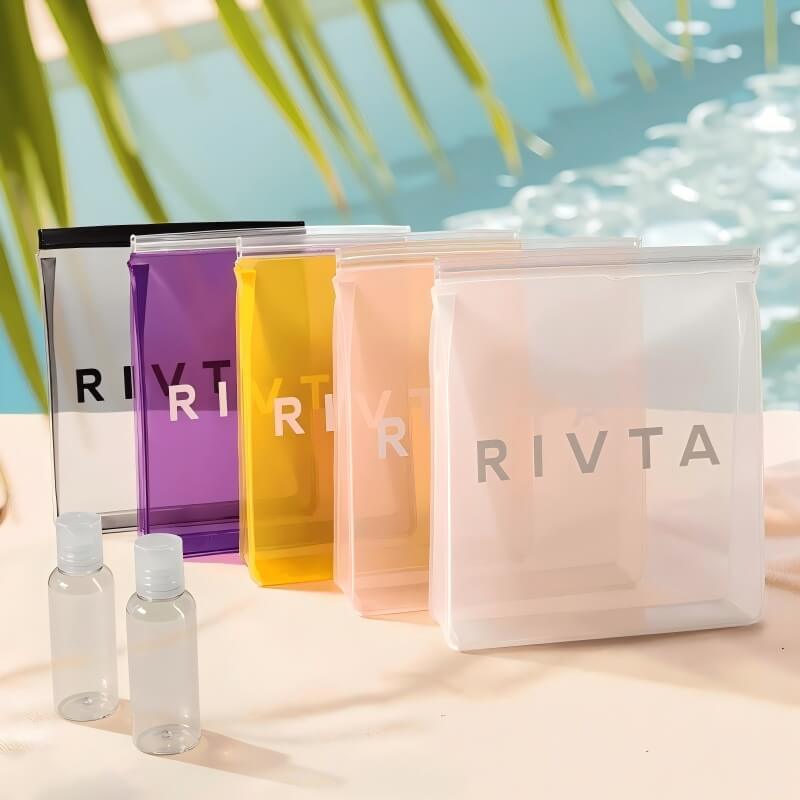
A TPU clear cosmetic bag can look premium in a product photo and still fail in sampling if seams wrinkle, odor remains, panels haze, edges scratch or filled products distort the pouch. Use this checklist to review TPU samples before bulk approval.
TL;DR
Buyers should not approve a TPU cosmetic bag from an empty sample photo or verbal QC assurance. A useful TPU checklist connects seam or weld consistency, odor after opening, clarity, haze, yellowing, scratches, zipper function, edge finish, filled-sample deformation, insert-card rub, carton protection and photo/video evidence to the actual Beauty GWP order. The purchasing conclusion is clear: approve the packed sample and QC evidence before bulk production, then use the same criteria for shipment review.
| Route filter | Procurement conclusion |
|---|---|
| Best fit | This guide is best for beauty founders, brand teams, private-label buyers and sourcing managers reviewing a TPU clear cosmetic bag, transparent pouch, sunscreen GWP pouch, travel-size beauty bag or clear launch-kit pouch with a real brand, target launch window and expected order around MOQ 500+ or higher. It fits projects where seam appearance, odor after sealed packing, panel clarity, zipper smoothness, product-fill deformation, insert-card rub, carton protection, market notes and supplier evidence affect the final approval. It is especially useful when the buyer already has a TPU sample or quote and needs to decide whether the route is ready for packed-sample approval or bulk production. |
| Less suitable | This guide is less suitable for single-piece personal orders, generic marketplace resale, no-brand projects, one-off event favors without production files or price-only sourcing where the buyer only wants a visible pouch. It is also not the right workflow when the team has no product fill, no packaging plan, no sample approval owner and no plan to review odor, haze, scratches, zipper function, carton handling or market requirements before bulk production. If the buyer has not chosen between PVC, EVA and TPU yet, material comparison should come first. |
Why does TPU QC need more than a visual sample photo?
TPU is often chosen for a softer, clearer and more premium-feeling clear pouch route. That does not mean every TPU sample is automatically ready for beauty retail or GWP use. QC still depends on material thickness, panel clarity, seam method, zipper placement, odor control, edge trimming and packing method.
A photo can hide haze, smell, fine scratches, corner stress and deformation after filling. A proper TPU review should combine visual checks, touch checks, odor checks, filled-product checks and packing checks. Buyers should ask the supplier to define what is acceptable before bulk production begins.
| QC area | What to inspect | Why Beauty GWP buyers care |
|---|---|---|
| Seam / weld | Wrinkles, gaps, whitening, uneven heat line, weak corners | Clear pouches expose every seam defect |
| Odor | Smell after opening, after ventilation and after packing | Beauty products sit close to the pouch |
| Clarity | Haze, yellowing, bubbles, color cast, deep scratches | Product visibility affects perceived value |
| Packing | Panel pressure, puller marks, insert-card rub, carton compression | Gift-ready appearance must survive shipment |
| Zipper / puller | Smooth opening, pull strength, slider alignment and scratch risk | Reuse depends on daily handling |
What are the top TPU QC problems buyers should watch first?
Most TPU issues are not dramatic failures. They are small defects that become obvious because the bag is transparent. A buyer may reject a sample because the seam looks cloudy, the front panel has micro-scratches, the zipper pulls unevenly, or the pouch smells too strong when opened after sealed packing.
| Top issue | How it appears | Supplier question |
|---|---|---|
| Cloudy seam | White line, wrinkle or uneven heat mark near edge | What seam method and tolerance will bulk follow? |
| Odor after opening | Noticeable smell when pouch is opened from polybag | What ventilation or packing process is used before shipment? |
| Panel haze | Products look dull or less visible through the pouch | Can the supplier show clarity and haze expectations? |
| Scratch / rub marks | Fine marks from pullers, inserts or stacked packing | How will panels and hardware be protected in cartons? |
| Packed deformation | Bag bulges, front panel bends or zipper line twists when filled | Can the supplier test the pouch with real product sizes? |
How should buyers check TPU seam quality?
TPU clear pouches may use controlled heat sealing, RF welding or stitched construction depending on design. The buyer does not need to become a technician, but should ask the supplier to identify the seam route and define the visual tolerance. A weak seam can fail functionally; a cloudy or wrinkled seam can fail visually even if the bag still holds together.
Check corners, zipper ends, handle attachment points, gusset transitions and any area where the material bends. If the pouch will hold liquid products, sunscreen tubes or travel minis, filled-sample review matters more than a flat empty sample.
| Seam check | Acceptable direction | Red flag |
|---|---|---|
| Heat or weld line | Even line, no open gaps, no severe whitening | Cloudy, wavy or partially open seam |
| Corner stress | Clean corner with no tearing or sharp edge | Corner cracks after bending or filling |
| Zipper end | Aligned and reinforced where needed | Gap near zipper end or uneven pull |
| Gusset transition | Shape holds when product is inserted | Wrinkle cluster or panel twist |
| Pull test | Supplier defines practical handling test | No seam-strength discussion before bulk |
How should odor be checked before approving TPU bags?
Odor should be checked in the condition the buyer will actually receive: after packing, after opening, and after short ventilation. A sample that smells acceptable after sitting open in the office may smell different when it arrives sealed in a polybag. For beauty campaigns, that matters because fragrance, skincare and makeup products should not be associated with a strong material smell.
Odor language should stay practical. The supplier should not use absolute zero-odor language. Instead, the buyer should define when odor is checked, how long the pouch is aired, whether the smell remains strong after opening, and whether the packaging method traps odor unnecessarily.
| Odor check | How to do it | Buyer decision |
|---|---|---|
| Fresh-open check | Open the packed pouch and evaluate immediately | Is odor strong enough to hurt unboxing? |
| Ventilation check | Air sample for a fixed period and recheck | Does odor reduce to an acceptable level? |
| Product proximity | Place beauty products inside for review | Does odor affect perceived product quality? |
| Carton condition | Review multiple units after carton packing | Is odor isolated or bulk-wide? |
| Supplier control | Ask how material and packing are handled | Can the issue be controlled before shipment? |
What evidence should buyers approve before bulk production?
Before bulk production, buyers should approve evidence that connects the TPU sample to the actual Beauty GWP order. The supplier does not need to turn every pouch into a lab report, but the approval file should show what was checked, what is acceptable and which shipment evidence will be shared before release.
| Issue | Evidence to request | RFQ note |
|---|---|---|
| Seams or welds look cloudy, wavy or weak. | Seam close-ups, corner photos, zipper-end photos and supplier tolerance note. | Name seam route and reject signals before sampling. |
| Odor appears after sealed packing. | Fresh-open check, post-ventilation check and carton-condition sample comments. | Define when odor is checked and what action is needed if it remains strong. |
| Clarity or panel appearance changes. | Front panel photo, side-angle photo, haze or yellowing note and scratch photos. | Approve clarity with real product fill and normal retail lighting. |
| Filled sample distorts the pouch. | Product-fill photo, packed-sample photo, zipper stress photo and carton orientation. | Ask supplier to test with real or dummy product sizes. |
| Packaging creates visible marks. | Insert-card rub check, puller protection photo, individual packing method and carton count. | Quote packing protection as part of the TPU route, not as a late fix. |
What clarity, haze and yellowing checks matter for TPU cosmetic bags?
Clear bags sell visibility. For Beauty GWP, that visibility can show sunscreen, fragrance minis, color cosmetics or skincare sets. The buyer should check whether the TPU panel looks clean under normal retail light, whether products remain visible, and whether the material has haze, bubbles, yellow cast or deep scratches. ASTM haze and light-transmission methods [5] can be useful technical references when formal testing is required, but most buyer approvals still begin with visual sample review.
| Clarity issue | What buyer sees | How to brief the supplier |
|---|---|---|
| Haze | Product looks dull through the panel | Define visual clarity expectation and sample approval standard |
| Yellowing / color cast | Panel shifts warm or grey under light | Ask for material batch consistency and storage guidance |
| Bubbles or specks | Small marks visible on front panel | Define major vs minor defect threshold |
| Deep scratches | Marks visible before use | Check handling, protective layers and carton packing |
| Logo visibility conflict | Print or patch reduces clear effect | Confirm logo method on physical TPU sample |
How should packing tests prevent deformation and scratches?
TPU bags can deform if they are packed too tightly, stacked with hard pullers, pressed by insert cards or shipped with product fill that pushes the panel. Packing tests should review the pouch the way it will ship, not only as a loose sample on a table. ISTA packaging procedures [4] can help frame distribution risk when carton compression or transit handling matters.
| Packing risk | Test condition | What to record |
|---|---|---|
| Panel pressure | Pack pouch flat or filled in expected carton count | Panel bends, dents or recovers |
| Puller marks | Check if zipper puller presses into clear panel | Scratch or indentation location |
| Insert-card rub | Pack with final card or sleeve | Ink transfer, scratch or pressure mark |
| Carton compression | Review top, bottom and side units after stacking | Deformation and carton mark accuracy |
| Filled-sample shipment | Test with real or dummy product fill | Leakage risk, panel distortion and zipper stress |
Which TPU QC photos should buyers attach before approval?
Photo evidence makes the QC discussion more practical. Ask for clear front-panel photos, seam close-ups, side-angle clarity checks, zipper-puller close-ups, filled-sample photos and carton packing photos. If rub, hardness, adhesion or tensile concerns are important, align the sample review language with the relevant test discussion instead of using vague words such as premium, strong or clear. Plastic film friction [8], hardness [9], adhesion [10], conditioning [11] and tensile-property [12] terms can be useful when a project needs formal discussion.
| Photo route | What to show | Why it matters |
|---|---|---|
| Clarity evidence | Side-by-side photos under normal light | Shows haze, color cast, panel transparency and logo visibility |
| Factory evidence | Seam, zipper, panel and packing photos from the sample review | Turns QC concerns into supplier-checkable evidence |
| Structure evidence | Finished-bag shape, zipper placement, edge finish and recovery | Shows whether the TPU pouch holds shape beyond one flat photo |
What zipper, puller and edge details should be checked?
A TPU pouch can fail through small handling details. The zipper may be hard to open because the material is too flexible. A metal puller may scratch the clear panel. A trimmed edge may feel sharp. A printed logo may crack if it sits on a stress point. These details should be part of the QC checklist rather than treated as decoration.
| Detail | QC check | Why it matters |
|---|---|---|
| Zipper smoothness | Open and close filled and empty sample | Controls daily reuse |
| Puller strength | Check attachment and pull direction | Prevents early breakage |
| Edge finish | Touch edge and corner areas | Protects premium handling feel |
| Logo method | Check print or patch after bending | Prevents cracking or distortion |
| Hardware contact | Review whether puller marks clear panel | Protects display appearance |
Which safety and market notes belong in a TPU QC review?
TPU QC is not only visual. Depending on the destination market and product type, buyers may need chemical restriction discussion, California Proposition 65 [1] warning review, EU REACH [2] restricted-substance review, CPSIA [3] or phthalate-related review, textile or trim safety documentation, or retailer-specific requirements. This article stays conservative: it does not say each TPU bag needs the same test package, and it does not treat one document as coverage for each market.
| Market / safety note | When to discuss it | Buyer action |
|---|---|---|
| Prop 65 | California retail or e-commerce exposure | Ask whether warning review is needed |
| REACH | EU-related channel or retailer review | Discuss restricted-substance expectations |
| CPSC / phthalates | Plastic material questions or specific retailer concern | Clarify whether any test route applies |
| OEKO-TEX | Textile trims, lining or brand requirement | Check OEKO-TEX scope [6], not just logo use |
| ISO 9001 | Quality-management review | Use ISO 9001 [7] as process context, not product proof by itself |
What can Ecorivta deliver for TPU cosmetic bag QC?
Ecorivta is a good fit when a Beauty GWP buyer needs a clear pouch or TPU cosmetic bag reviewed as a real campaign item, not just a transparent sample. Practical project inputs include product fill, target size, material preference, logo method, packaging scope, market, quantity and sample deadline.
Existing clear pouch formats may be reviewed around 500-1,000 units when the structure is simple. Semi-custom TPU programs with logo, zipper, insert card or sleeve planning are more practical around 1,000-3,000 units. Multi-version travel retail, filled-sample packing or custom structure usually belongs in 3,000-5,000+ unit planning.
| Buyer need | Ecorivta can help review | What should still be confirmed by the buyer |
|---|---|---|
| TPU sample QC | Seam, odor, clarity, scratches, zipper and edge finish | Target tolerance, sample approval standard and final product fill |
| Packed-sample review | Panel deformation, puller pressure, insert-card rub and carton protection | Final packaging route, carton count and launch handling rules |
| Market-risk discussion | Prop 65, REACH, CPSIA, OEKO-TEX or retailer-document topics when relevant | Destination market, retailer rules and claim wording |
| Production readiness | QC checklist, sample photos, sample comments and approval gates | Quantity, deadline, artwork, approved quote scope and final sample signoff |
What does a composite TPU QC case teach?
Case note: The following case combines recurring TPU clear pouch issues seen across Beauty GWP projects. It is anonymized and simplified for buyer education; it is not a single client disclosure.
A fragrance and sunscreen GWP program selected a TPU clear pouch because the buyer wanted soft handfeel, product visibility and a more premium clear-bag route. The first sample looked clean in flat photos, so the team nearly approved it from the front view. When the buyer tested the pouch with real product fill, three issues appeared: mild odor after opening the sealed polybag, fine puller scratches on the front panel and panel deformation when two sunscreen tubes pressed against the zipper line. The insert card also rubbed the inside panel after packed handling, which made the pouch look used before the customer opened it.
The supplier did not need to redesign the whole item. Instead, the approval file became more specific. The team added a fresh-open odor check, a short ventilation review, puller protection, adjusted insert-card position, wider opening width and carton packing photos. The revised sample was tested with dummy products in the same size as the final sunscreen set. Photos showed the seam, zipper end, front panel, side angle, packed pouch and carton orientation. The final route stayed TPU, but the QC criteria became visible and repeatable. The lesson is that TPU QC should be approved under real product-fill and packing conditions. An empty transparent pouch can look ready while the packed GWP still needs seam, odor, clarity, zipper and carton evidence before bulk approval.
| Issue found | QC action | Buyer lesson |
|---|---|---|
| Odor after sealed packing | Review fresh-open and post-ventilation sample | Odor check must match shipping condition |
| Puller scratches | Add packing protection and adjust puller position | Hardware can damage clear panels |
| Panel deformation | Approve with actual product fill | Empty sample approval is not enough |
| Insert-card rub | Review card material and placement | Packaging can create visible defects |
What did three anonymous buyers say after TPU QC review?
| Role | Before review | After review |
|---|---|---|
| Founder | The team judged the pouch from an empty front-view photo. | The final approval used filled-sample photos, odor notes and panel clarity checks. |
| Procurement lead | Supplier answers mixed material route, packing protection and QC evidence in one quote line. | The revised RFQ separated TPU sample review, packing method and shipment evidence. |
| Quality manager | Scratches and deformation were discussed only after the sample arrived. | The checklist made puller protection, insert-card rub and carton orientation part of approval. |
How is this different from related clear bag and quality guides?
This article is the TPU sample-QC route. It assumes TPU is already being considered and focuses on seam, odor, clarity, scratches, zipper, packed-sample deformation and carton protection. Related guides answer adjacent questions, but they should not replace this checklist when the buyer is approving a physical TPU sample.
| Sibling guide | Use that guide when | Use this guide when |
|---|---|---|
| PVC vs EVA vs TPU guide | The buyer still needs to choose the clear material route. | The buyer has a TPU route and needs sample QC criteria. |
| Clear bag supplier quality checklist | The question is supplier capability and clear bag production behavior. | The question is whether this TPU sample is ready for approval. |
| Cosmetic bag quality demand checklist | The team needs a broader product-quality checklist across materials and formats. | The TPU clear pouch needs material-specific seam, odor and clarity review. |
| Beauty GWP Solutions | The team is planning the full campaign route and related GWP formats. | The clear TPU pouch is already the selected format and needs QC approval. |
What should buyers not expect from a TPU QC checklist?
- Do not expect absolute zero odor, zero scratch or zero color variation without a defined test and tolerance.
- Do not assume TPU automatically solves every PVC or EVA concern; material choice and QC are separate decisions.
- Do not approve a clear pouch only from a front-view photo.
- Do not treat a supplier certificate as proof that the packed sample will look good after shipment.
Which related Ecorivta page should buyers use next?
| Route | Use when | Open page |
|---|---|---|
| Clear bag product route | The buyer needs the product page for clear cosmetic, travel and GWP pouch options. | Clear Cosmetic Bag |
| Material decision route | The buyer still needs to decide between PVC, EVA and TPU before QC review. | PVC vs EVA vs TPU Guide |
| Sourcing route | Supplier selection, sample timing and clear pouch sourcing risk are the main issue. | Clear Bag Sourcing Review |
| Supplier quality route | The question is supplier capability, not only TPU sample QC. | Supplier Quality Checklist |
| Beauty GWP route | The clear pouch is part of a broader skincare, sunscreen or travel retail campaign. | Beauty GWP Solutions |
| RFQ review route | The buyer has a TPU sample, product fill and QC concerns ready for supplier review. | Send QC Brief |
What copy-ready TPU QC brief can buyers send?
| Brief section | Fields to send | Purpose |
|---|---|---|
| Product fill | Product dimensions, count, weight and residue risk | Checks shape, zipper stress and panel deformation |
| Material route | TPU preference, thickness if known, clarity expectation | Sets sample and QC expectation |
| Seam / edge | Target seam method, corner stress concern, edge feel | Controls strength and visual finish |
| Odor / clarity | Fresh-open odor check, haze and scratch tolerance | Protects beauty product perception |
| Packing | Insert card, sleeve, puller protection, carton count | Prevents transit marks and deformation |
| Market / document | Destination market, warning review, retailer requirements | Frames safety and documentation discussion |
Copy-ready note
We are reviewing a TPU clear cosmetic bag for a Beauty GWP program. Please check seam quality, odor after sealed packing, panel clarity, scratch risk, zipper function and packed-sample deformation using the attached product-fill list and packaging plan.
When these fields are ready, send the sample and QC concerns through the Ecorivta contact page.
Need a TPU cosmetic bag QC review before bulk approval?
Share product fill, sample photos, target quantity, packaging scope and destination market. Ecorivta can help translate TPU concerns into a clearer supplier QC checklist.
About the author
Lina Lv works with beauty brands on custom cosmetic bags, Beauty GWP clear pouches, TPU sample reviews, material routes, packaging scope and supplier-ready RFQ files. Her writing focuses on practical sourcing decisions that help buyers translate sample concerns into evidence, approval criteria and bulk-production controls.
Trademark notice
Brand names, certification names, retailer names and standard names mentioned in this article belong to their respective owners. They are used for buyer education and sourcing context only. Ecorivta does not claim ownership of third-party trademarks, and buyers should confirm current trademark, certification and labeling requirements with the relevant owner, certifier, retailer or legal advisor before using marks or claim wording in public packaging, inserts or campaign materials.
FAQ
What should buyers check on a TPU cosmetic bag sample?
Buyers should check seam strength, weld or stitch consistency, odor, panel clarity, haze, yellowing, scratches, zipper function, edge finish, packed-sample deformation and carton protection.
Is this article a PVC vs EVA vs TPU material guide?
No. Material selection belongs in the PVC, EVA and TPU guide. This article assumes TPU is being considered and focuses on QC checks before sampling, approval and bulk production.
Can a supplier state that a TPU bag will never smell or scratch?
No. Suppliers can control material selection, ventilation, packing and QC thresholds, but buyers should approve real samples and define acceptable odor, scratch and clarity limits.
Which tests matter most for a clear TPU Beauty GWP pouch?
The most practical checks are seam or weld quality, odor after opening, clarity and haze, scratch resistance under packing, filled-sample deformation and zipper or puller durability.
When should buyers contact Ecorivta about TPU bag QC?
Contact Ecorivta when you have product fill, target quantity, material route, sample photos, packaging scope and the QC risks you want checked before bulk approval.
Sources
- California Proposition 65 warnings. Source ↩
- European Commission, REACH overview. Source ↩
- U.S. Government Publishing Office, CPSIA public law text. Source ↩
- ISTA, transport packaging test procedures. Source ↩
- ASTM D1003, haze and luminous transmittance. Source ↩
- OEKO-TEX, STANDARD 100. Source ↩
- International Organization for Standardization, ISO 9001 quality management. Source ↩
- ASTM D1894, plastic film friction. Source ↩
- ASTM D2240, rubber hardness. Source ↩
- ASTM D3359, tape adhesion. Source ↩
- ASTM D618, plastics conditioning. Source ↩
- ASTM D882, thin plastic sheeting tensile properties. Source ↩
References support market-warning context, restricted-substance review, packaging tests, haze terminology, textile safety, quality-management context and practical plastic-film QC language. Final QC requirements should still follow the buyer’s destination market, retailer requirement and project-specific sample approval record.
Trademark Notice: All third-party trademarks, logos, and brand names mentioned on this page are the property of their respective owners. Their mention indicates a contract manufacturing relationship only and does not imply endorsement, sponsorship, affiliation, or partnership. All client engagement details, including project specifications, volumes, timelines and pricing, are confidential under mutual non-disclosure agreements.