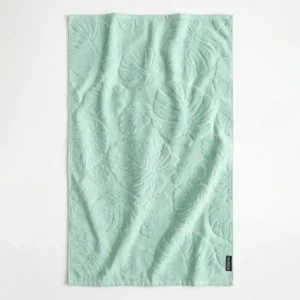
A cotton-feel sample and an approved US beach towel fiber label are two different decisions. For a Beauty GWP towel entering a US retail program, the sample may look ready while the label still depends on an unconfirmed fabric specification, business name or origin statement. Resolve those fields before releasing printed labels and packaging.
This guide helps a beauty-brand buyer assemble a US beach towel fiber label brief with the evidence and artwork needed for review. The importer or brand’s compliance owner should confirm the requirements for the finished item and its distribution route.
Quick Buyer Summary
- Prepare the US beach towel fiber label from the verified composition of the selected construction, not just a description of its face or handfeel.
- If terry loops and ground use different fibers, the fiber declaration must account for both.
- Confirm and approve the responsible business identification and country-of-origin wording alongside the fiber statement.
- Review the label on the actual towel and in the approved fold, pocket or outer pack.
- Release one version-controlled label file tied to the material reference, sample and Beauty GWP SKU.
Start with the construction options on our custom beach towel page. This label review follows material selection; it does not replace it.
Share your US towel project brief
A cotton surface does not describe the whole towel
For a terry towel, distinguish the loops from the ground fabric that holds them. The FTC’s cotton-labeling guidance 1 explains that when those parts use different generic fibers, the declaration must account for their respective fiber weights. Reporting only the pile or only the backing is not enough.
For a Beauty GWP brief, ask the supplier to connect the stated composition to the exact fabric reference being quoted. A swatch labeled “cotton terry” is a starting description, not a complete approval file. Likewise, a smoother print face does not establish what the reverse or ground contains.
| What the supplier provides | What the buyer still needs | Release decision |
|---|---|---|
| “Cotton loops” only | Ground composition and the fiber-weight basis for the complete declaration | Hold label artwork until the missing construction data is supplied |
| Verified composition for the complete towel fabric | A record identifying the fabric, supplier reference and sample that the statement covers | Send the supported wording to the label reviewer |
| Different fabrics in a towel and an attached pocket | A component map and a decision on how each part is treated in the final disclosure | Ask the compliance owner to resolve the label scope before combining the wording |
For example, consider a hypothetical fabric with cotton loops contributing 70% of its fiber weight and a polyester ground contributing 30%. Its overall composition is 70% cotton and 30% polyester. Calling that fabric “100% cotton” because its loops are cotton would omit the ground. This calculation illustrates the decision; it is not an Ecorivta product specification.
The same FTC guidance also permits a separate-parts format for pile fabrics: the loop or face and the ground or backing can be listed separately when the label also states each part’s share of the fabric’s total fiber weight. Use that route only when the part weights are verified and the project’s compliance owner approves the final wording.
Do not estimate those weights from photographs, surface area or GSM. If the material record is incomplete or inconsistent, ask for clarification or an appropriate fiber-composition test before approving the wording. The required evidence should identify the material that will actually enter production.
Build one US beach towel fiber label brief with named owners
The FTC’s textile-labeling guide 2 includes towels among covered products and describes fiber content, origin and responsible-business identification. It also addresses English disclosures and accessible, legible labels. These are separate fields to resolve, even when they appear in one small artwork file.
| Brief field | Evidence or decision to attach | Suggested approval owner |
|---|---|---|
| Towel identity | Beauty GWP SKU, fabric code, selected color and dated sample reference | Buyer and supplier |
| Fiber statement | Verified composition and the components it covers; unresolved components listed separately | Supplier provides data; compliance owner approves wording |
| Business identification | Exact business name or valid RN selected for this supply route | Brand or importer |
| Country of origin | Confirmed origin wording supported by the actual manufacturing route | Importer with its customs adviser |
| Label construction | Artwork dimensions, attachment position, orientation and accessible reading area | Buyer, supplier and compliance owner |
| Pack and copy | Matching sleeve, insert and product-description versions | Packaging and brand teams |
An RN is optional, not an extra certification to request from every supplier. The FTC’s RN FAQ 3 explains the business-name alternative and who can obtain an RN. A campaign logo is not automatically the required business identification. Ask the responsible company to provide and approve the exact entry; do not copy a number from another label.
Origin needs its own evidence. CBP’s textile import guidance 4 identifies country-of-origin marking as an import requirement and notes the complexity of products made across countries. Do not infer origin from the supplier’s address, dispatch port or location of the final logo application. Give the importer the manufacturing-route details it needs to confirm the statement.
Keep the finished-item scope explicit. Adding a towel to a Beauty GWP set does not establish a labeling exemption. A gift box containing several accessories also does not establish that one statement describes every component.
Send your towel material and label questions
Check the label in the towel’s delivered form
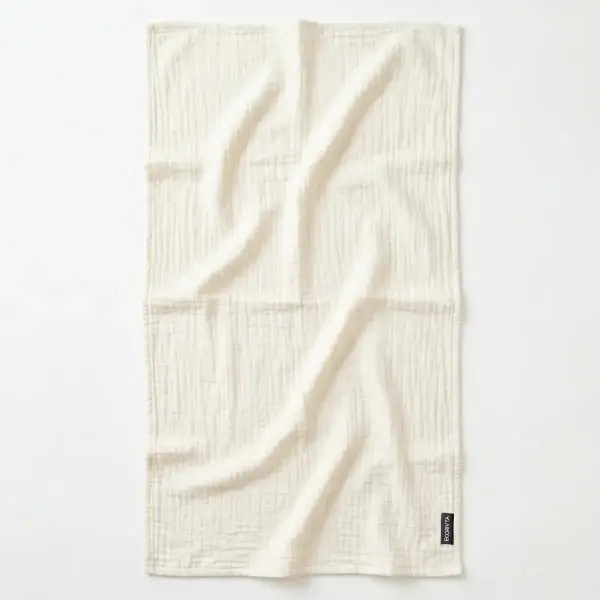
A readable artwork proof can still be awkward when sewn into a thick hem or folded into a self-pack pocket. Ask for three views: the complete towel with the attachment point visible, a close-up of the attached label, and the packed presentation. Use the actual sample to check whether the text remains readable and the relevant information can be found.
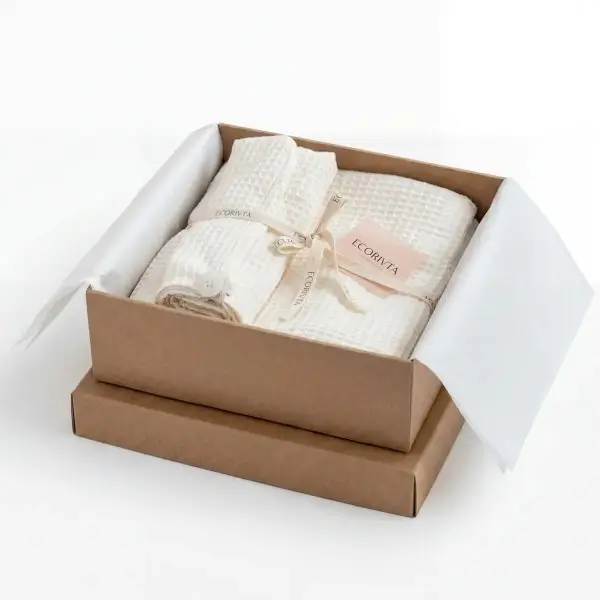
Where a pocket or separate sleeve uses a different material, identify it in the component map rather than extending the towel’s fiber description to it by habit. Its treatment depends on the construction and applicable rules. The product photograph cannot settle that question.
For Beauty GWP projects using a sleeve, band or box, review the towel label together with any fiber claims on that packaging. Mark a mismatch as an unresolved approval item. Do not let the pack designer work from an earlier material option after the buyer has changed the fabric.
Ask the compliance owner whether the retail package also needs the required disclosures. The FTC packaged-product guidance2 generally calls for the information on both the item and its package. It identifies exceptions for transparent packaging whose labels can be read without opening, and packaging used solely for mail-order shipment. An opaque gift box should trigger a packaging-label decision as well as a copy check.
Our beach towel sample approval guide covers the wider physical review, including dimensions, logo and pocket construction. Keep those checks in that workflow; this handoff focuses on what the label says, what evidence supports it and which artwork goes into production.
Release the artwork against a specific sample
The practical deliverable is a short label release record, not another general request to “make it compliant.” Keep these items together:
- Material evidence: the selected reference and composition record, with any open question clearly marked.
- Approved copy: the reviewed fiber, business and origin entries, plus the file’s revision number.
- Physical placement: the attached-label photo and packed-view photo for the approved sample.
- Matching files: the sleeve, insert or other copy that repeats a material statement.
- Sign-off: the named approver, approval date and remaining conditions.
If a towel fabric, pocket material or manufacturing route changes, reopen the affected entries before reusing the US beach towel fiber label file. If only a campaign graphic changes, compare the new artwork with the approved information so a required line is not lost during redesign. Keep the previous revision as a reference, clearly separated from the released file.
For your next Beauty GWP towel brief, send the destination market, campaign quantity, chosen towel reference, current composition information and proposed packing to Ecorivta’s beach towel team. Include the label artwork if it already exists, and identify any field the importer still needs to resolve.
For an initial placement discussion, send the towel reference and packing photo by WhatsApp. Use the contact form to start the full brief and agree how to share the artwork files.
Questions buyers ask before label approval
Can cotton loops justify a 100% cotton towel label?
Only when the verified composition supports the complete statement. If the ground contains polyester, the fiber declaration must account for that contribution. A cotton loop description alone does not establish the whole towel’s composition.
Is an RN mandatory for a US beach towel label?
No. The FTC permits an appropriate business name instead of an RN. The brand or importer should confirm the exact identification for the supply route; a logo or campaign name is not automatically a substitute.
Does microfiber tell us the fiber composition?
No. Ask for the generic fiber names and verified percentages for the selected fabric. A microfiber description by itself is not the composition record needed to prepare the label.
When should we reopen an approved label file?
Reopen it when a material, component, responsible business or manufacturing route changes in a way that could affect the approved information. Check revised packaging copy against the same record before production release.
Evidence Used in This Brief
FTC — Calling It Cotton — Towel-specific guidance on fiber declarations for loops and ground. ↩︎
FTC — Threading Your Way — Covered products, disclosure fields and labeling mechanics. ↩︎
FTC — Registered Identification Number FAQ — Business-name and RN identification alternatives. ↩︎
CBP — Regulations for Importing Textiles — Textile import origin-marking context; individual origin decisions require the actual production facts. ↩︎
Product photographs are Ecorivta towel-family references, not evidence of an approved US label or a named customer order. Confirm the selected construction and label artwork against the project sample.