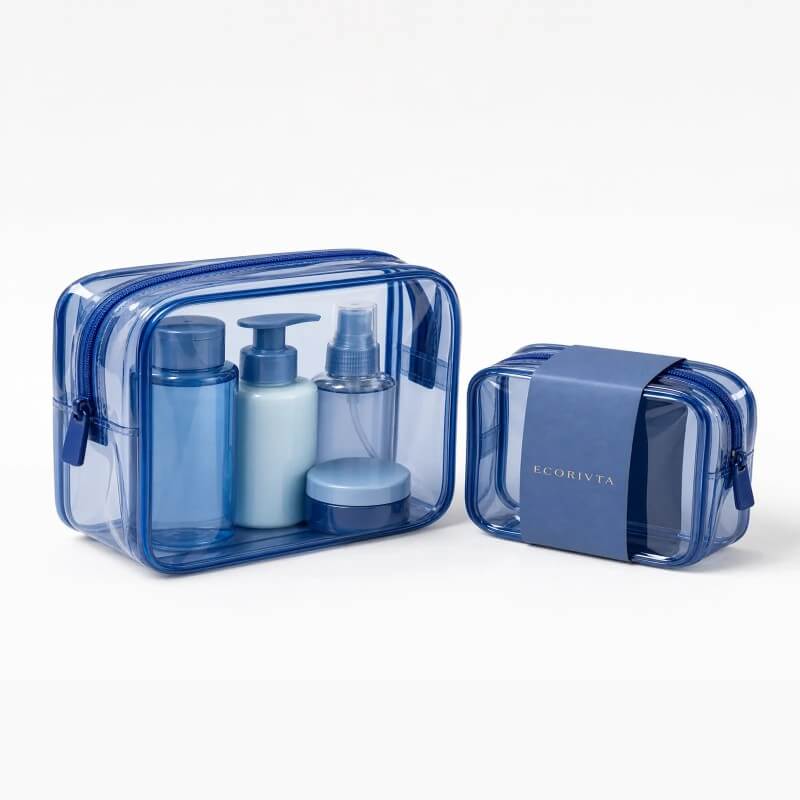
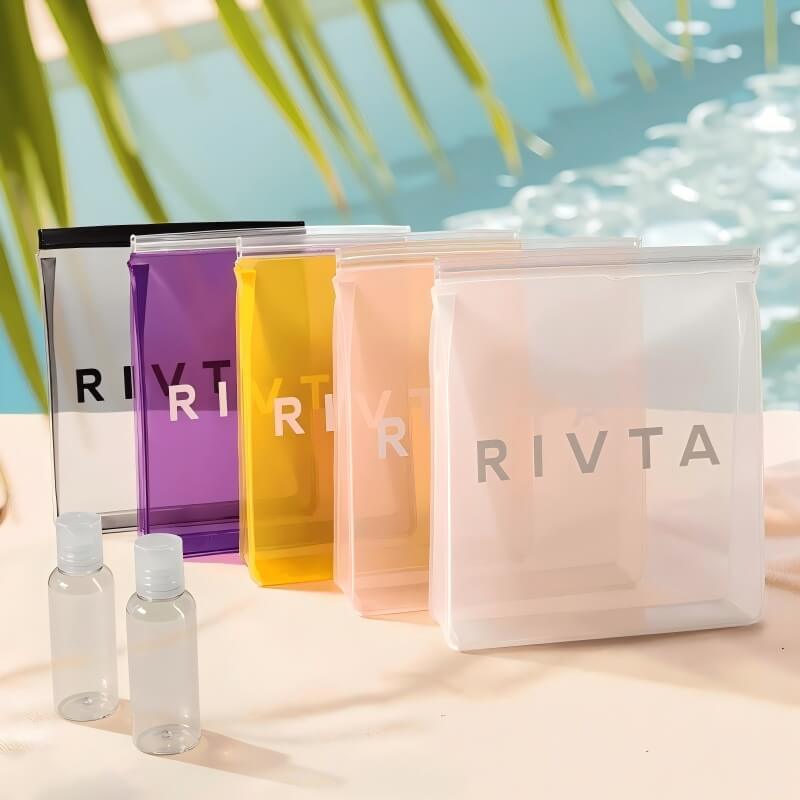
A clear cosmetic pouch for beauty GWP should be reviewed as a material and packing route, not only as a transparent bag. Buyers need to confirm PVC, EVA or TPU, clarity, softness, odor review, logo method, insert card, barcode, carton mark and travel retail packing before sampling.
This article supports Ecorivta’s clear cosmetic pouch materials page [1]. It is written for beauty buyers who need a transparent pouch for travel retail, skincare minis, summer sets, PR mailers or beauty GWP programs. The article uses 3-1-1 size context, but it does not claim that any pouch is approved by an authority.
Quick Summary
- Clear pouch sourcing starts with material route. PVC, EVA and TPU differ in clarity, softness, odor review, print method and target price.
- Travel retail packing is a file handoff problem. Insert card, barcode, market label and carton mark should be confirmed before bulk packing.
- Use 3-1-1 as size context only. Do not write approval language unless the buyer has their own verified requirement.
- Transparent products show mistakes quickly. Dust, wrinkles, cloudy material, logo shift and insert card size are easy to see.
- Ecorivta should receive use, market and target price early. Those details help the team recommend the right clear material route.
| Send Your Clear Pouch RFQ Use this route when you already know the product direction and need Ecorivta to review material, size, quantity, target price and packing route. |
Why clear pouch packing matters
A clear pouch looks simple because the buyer can see the product at once. That is exactly why the sourcing details matter. Any cloudy material, uneven seam, strong odor, crooked logo, scratched surface or mis-sized insert card is visible. A clear pouch for beauty GWP should be reviewed before sampling as a finished presentation route.
If the buyer needs a broader soft pouch route, the cosmetic bag page [2] may fit better. If the pouch is part of a set with other beauty accessories, the Beauty GWP hub [3] gives the broader context. For transparent pouches, this page focuses on travel retail packing, 3-1-1 size context and material handoff.
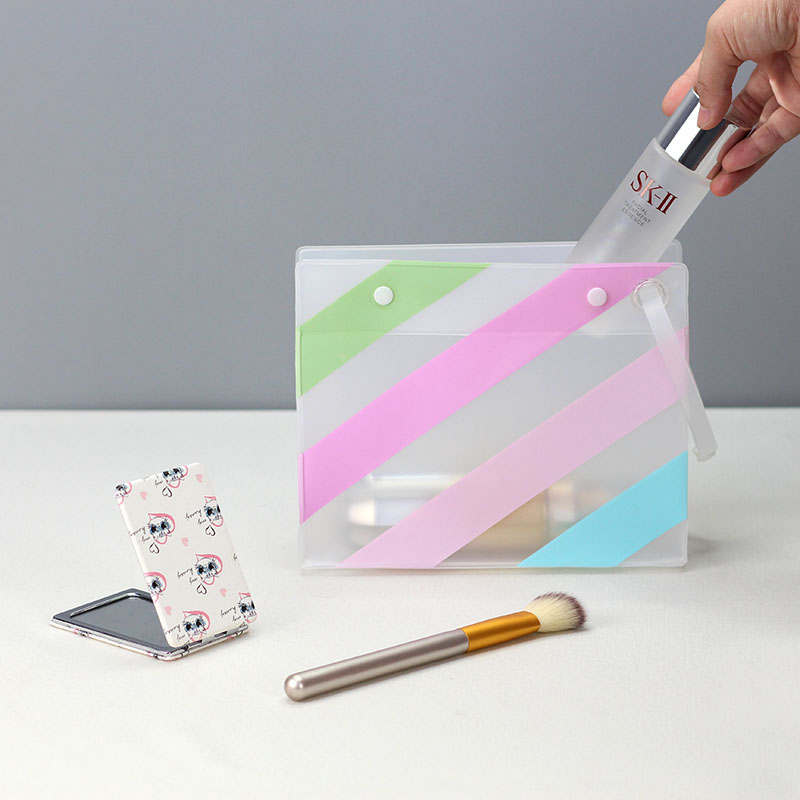
PVC, EVA and TPU route comparison
| Material route | Buyer should review | Common use |
|---|---|---|
| PVC | Clarity, smell, thickness, softness, print method and market acceptance. | Cost-sensitive clear pouches and promotional packing. |
| EVA | Softness, matte or frosted look, transparency and folded card fit. | Beauty GWP and softer travel pouch programs. |
| TPU | Clarity, flexibility, surface feel, target price and logo compatibility. | Premium clear pouch route when handfeel matters. |
Material selection should not be made by photo only. Buyers should share target price, launch date, quantity, target market and use case. If the buyer has environmental wording in mind, the wording should be reviewed carefully with references such as the FTC Green Guides [8].
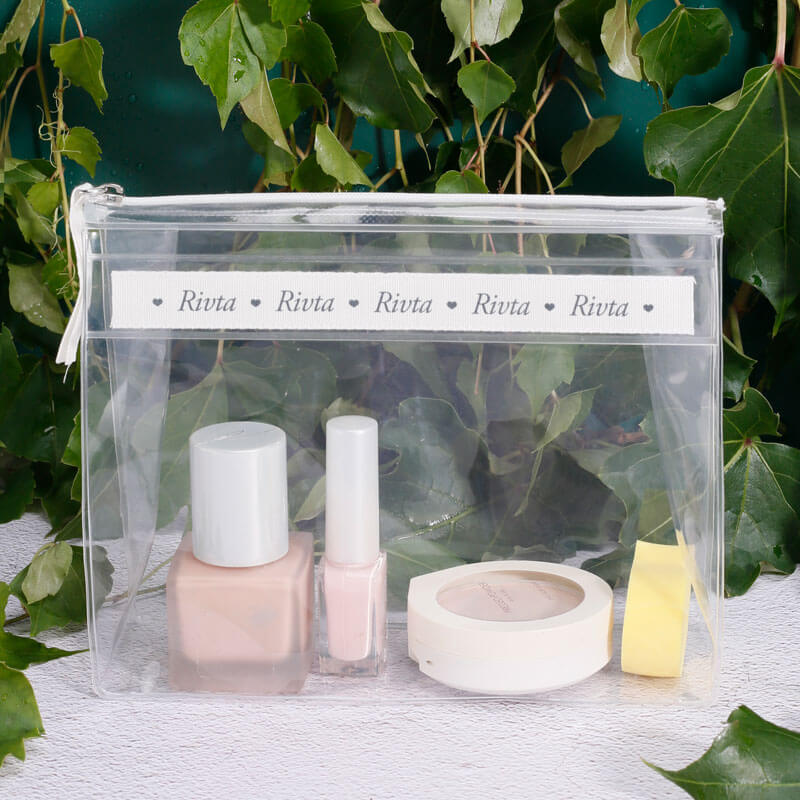
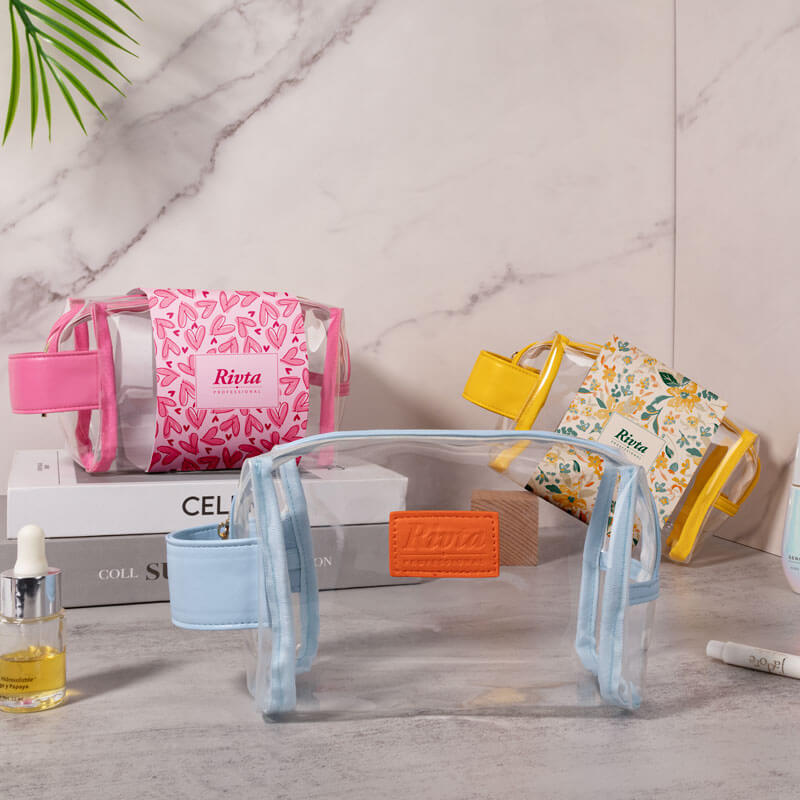
The 12-point clear pouch packing checklist
| 1. Use case Travel retail, beauty GWP, skincare minis, PR mailer, retail sale or airport retail context. |
2. Size Outer dimensions, usable capacity, insert card size and product contents. |
| 3. Material route PVC, EVA or TPU by clarity, softness, odor review and target price. |
4. Thickness Material thickness and finished handfeel after stitching or heat sealing. |
| 5. Logo method Silkscreen, heat transfer, patch, label or printed card branding. |
6. Insert card Card size, paper thickness, fold line, printed language and market version. |
| 7. Barcode Barcode owner, label size, file format and placement. |
8. Carton mark SKU, PO, market, destination and warehouse requirement. |
| 9. Individual packing Polybag, paper sleeve, tissue, hangtag or set assembly route. |
10. Surface risk Scratch, dust, crease, cloudy material and static marks. |
| 11. Sample approval Material, logo, insert card and packing sample before bulk. |
12. Shipment evidence Photos of clear pouch, logo, card, barcode, carton and packed goods. |
3-1-1 size context without risky claims
Many buyers ask for clear pouches because they are thinking about travel. The TSA liquids rule [6] is a useful public reference for 3-1-1 context. The safe sourcing language is to discuss dimensions and buyer-side travel use. Do not describe a product as approved or compliant unless the buyer’s own legal or retail team has verified the exact claim for that market.
Ecorivta can review pouch dimensions, material thickness and intended contents. If the buyer is comparing true clear travel pouch demand, Ecorivta’s TSA clear bags page [4] can be used as a product-route reference, while the buyer should still confirm the final travel claim, packaging copy and market wording. This distinction protects both the buyer and the supplier from overclaiming.
| Ask Ecorivta to Review the Route Use this route when material, logo, target price, 3-1-1 size context or launch timing still needs comparison before sampling. |
Logo, insert card and retail label handoff
Transparent pouches often use subtle logo routes. A small printed mark, a patch, a label or an insert card may be more appropriate than a large logo on the pouch body. If the buyer wants the products inside to be visible, the insert card and logo should not block the visual purpose of the clear material.
Barcode planning should happen before packing. GS1 barcode guidance [7] is useful background for why barcode ownership and label structure matter. The manufacturer should know whether the buyer will supply barcode artwork, whether the barcode sits on the insert card, sleeve or sticker, and whether each market needs a different version.
Carton mark and pre-shipment evidence
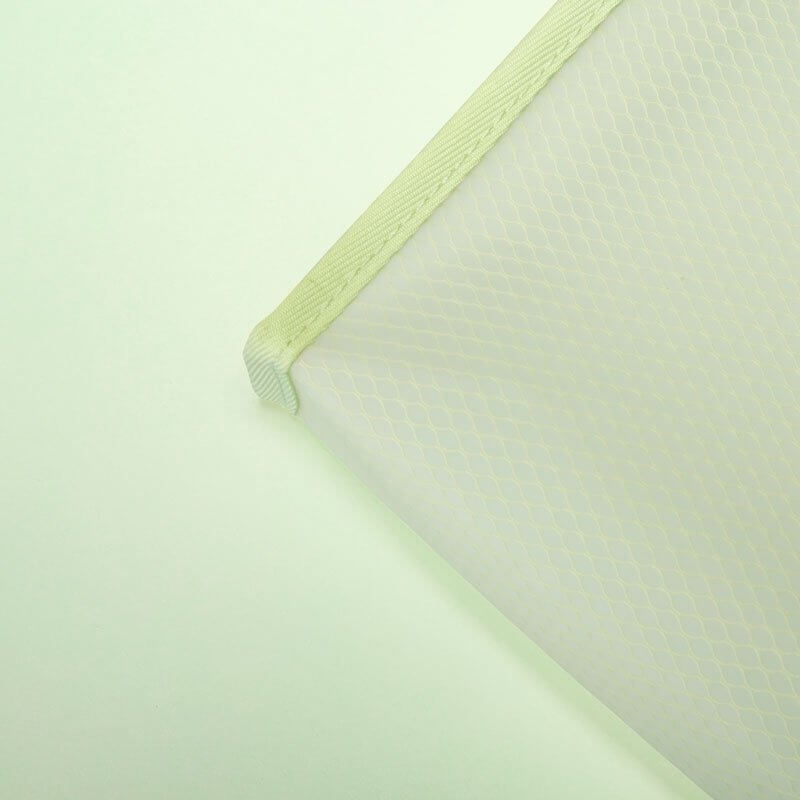
Clear pouches can be damaged visually during packing if surface protection is ignored. The buyer should ask what photos or videos will be sent before shipment: product view, logo, insert card, barcode, individual packing, inner carton, master carton and carton mark. If the pouch has a frosted finish or soft TPU surface, the team should also check whether stacking or tight packing creates marks.
Responsible sourcing questions may come from retail programs. Sedex SMETA [10] can be used as external audit language context. Material safety questions may refer to textile and material testing context such as OEKO-TEX STANDARD 100 [9] where relevant.
Composite case: a clear pouch packing file changed the quote
Composite case: a 2026 Q2 EU skincare brand requested 4,000 clear pouches for a travel retail mini set. The first request only listed size and a target price. After review, the buyer added a printed insert card, two market versions, barcode label, individual bag and carton mark for a retail warehouse.
The unit price changed because the project was not only a clear pouch. It was a travel retail packing route. Ecorivta reviewed EVA and TPU options, card size, logo placement and packing evidence. The final route kept the transparent presentation, but the buyer had a clearer file list before sampling.
RFQ file handoff for clear pouch travel retail programs
Clear pouch projects often look easy until the file handoff starts. The buyer may approve the pouch shape, but the order can still slow down because the insert card, barcode label, market language, carton mark and packing method arrive late. A clear pouch for travel retail or beauty GWP should be treated as a small packaging system. The pouch, the card, the label and the carton must work together.
The first RFQ should include the intended contents. A pouch for three skincare minis has a different usable volume from a pouch for brushes, hair accessories or sample sachets. The buyer should send approximate item dimensions, not only the pouch size. This helps Ecorivta check whether the pouch opens easily, whether the products sit properly, and whether the insert card blocks the view of the contents.
Logo files should be reviewed before sampling. Clear materials can make printing defects more visible because the background is not forgiving. A logo that looks acceptable on an opaque cosmetic bag may look heavy, crooked or unclear on transparent material. Buyers should send vector artwork and allow Ecorivta to recommend print size, print position, label route or card branding if the logo is too detailed for the pouch surface.
Retail label files should also be discussed early. Some buyers want the barcode on the insert card. Others need a sticker on the individual bag or a label on the carton. If there are multiple markets, each version may need different language or SKU information. Those differences should be listed before sampling so the factory understands whether the order is one simple batch or several packing versions.
Material risk review before approving PVC, EVA or TPU
PVC, EVA and TPU should not be compared only by price. Clear pouch buyers should also review clarity, softness, smell, crease behavior, surface marks, seam method, printing behavior and packing protection. A lower-cost material can be appropriate for a promotional pouch, but it may not fit a premium beauty gift set if the buyer expects a softer handfeel or clearer surface.
Odor review is practical, not cosmetic. Clear plastic materials can carry smell from material, processing or packing. The buyer should ask how the sample and bulk goods will be aired, packed and checked. If the pouch is used for skincare minis or beauty retail, a strong odor can damage the user’s first impression even if the pouch is technically usable.
Surface protection should be part of the route. Transparent products show scratches, dust and pressure marks easily. A pouch packed too tightly can arrive with creases or cloudy areas. Ecorivta should know whether the buyer wants individual bags, tissue, sleeve, separator or loose carton packing. These choices may look minor, but they affect whether a clear product still looks clean when the buyer receives it.
Environmental wording should be handled with care. If a buyer wants recycled, sustainable, PVC-free or alternative material language, the RFQ should ask what documentation can apply to the selected material and order. It should not assume that a material name alone gives a safe claim. The better process is to review claim wording, document availability and market expectation before the buyer prints packaging copy.
Travel retail claim boundary and buyer-side approval
Travel retail programs often create pressure to use strong wording. Buyers may ask for a pouch that is airport friendly, 3-1-1 size, travel size or suitable for liquid minis. Ecorivta can help review size, material and packing route, but the final wording should stay within the buyer’s verified claim boundary. The supplier should avoid saying that a pouch is approved by an authority unless the buyer has the exact legal basis.
A safer RFQ asks for dimensions, material route, intended contents and destination market. If the buyer uses 3-1-1 context, the pouch size and product contents should be checked against the buyer’s own travel retail requirements. Ecorivta can provide product and packing evidence, while the buyer confirms the marketing copy and retail compliance wording with their own team.
Travel retail also changes display risk. A clear pouch may be handled, stacked, scanned and repacked more often than a simple GWP shipped directly to a warehouse. The insert card should stay flat, the barcode should scan cleanly, and the pouch should not look scratched after normal packing. Buyers should ask for pre-shipment photos that show not only the product, but also the actual packing sequence.
When the buyer compares quotes, the lowest initial unit price is not necessarily the lowest-risk route. A slightly better material, clearer logo method or more controlled individual packing may prevent rework and brand complaints. The RFQ should make these priorities visible so Ecorivta can compare the right routes instead of only reducing the pouch to a unit price.
Quote review examples for clear pouch buyers
If a skincare brand needs a transparent pouch for minis in a travel retail set, the strongest quote should show the material route, usable size, insert card size, print method, individual packing and carton mark. A quote that only says “clear pouch with logo” is too weak for a retail program because it hides the details that control packing risk.
If a beauty brand needs a low-cost summer GWP, the route may focus on simple EVA or PVC-style material, a small logo, a paper card and standard carton packing. That route can be practical when the pouch is a giveaway container. It may not be the right route if the buyer expects a premium handfeel, clearer surface or softer material.
If a travel retail buyer needs multiple country versions, the quote should separate product cost from packing version cost. The pouch may be the same, but insert cards, barcode labels, carton marks and market language can create different production batches. Ecorivta should know whether the buyer wants one master design or several market-specific versions.
If the buyer has a sustainability story, the quote should not rely on vague wording. The RFQ should ask what material options are available, what documents can apply by order, and what wording the buyer plans to print. This prevents a situation where the pouch is sampled first and the claim discussion only starts after the retail card is designed.
If the buyer has not decided between a pouch-only order and a complete set assembly, the RFQ should say that clearly. A pouch-only order can move through material, logo and carton review. A set assembly order may need component counting, inner packing sequence, insert-card orientation and final packed-weight confirmation. These details change the factory conversation from simple pouch production to launch-ready packing support.
These quote examples show why a clear pouch article should sit close to the material page and contact form. The purpose is not to teach generic travel advice. The purpose is to help the buyer send enough information for a real RFQ: product use, target price, launch date, material route, dimensions, logo file, insert card, barcode, carton mark and pre-shipment evidence. That makes the first reply more useful for sourcing, costing and launch planning.
FAQ
Can Ecorivta say a clear pouch is approved by TSA?
No. The safer wording is to discuss 3-1-1 size context and buyer-side travel use, while avoiding approval or compliance claims unless the buyer has their own verified requirement.
Which material should buyers compare for clear cosmetic pouches?
Buyers should compare PVC, EVA and TPU by clarity, softness, odor review, logo method, target price, packing route and market expectation.
What packing details change a clear pouch quote?
Insert card, sleeve, barcode, carton mark, individual bag, set assembly and market version can all change cost and lead time.
When should insert card size be confirmed?
Insert card size should be confirmed before sampling because card thickness, pouch size and fold position affect presentation.
What should buyers send for a clear pouch RFQ?
Send use case, target price, launch date, quantity, preferred material, dimensions, logo file, insert card, barcode and carton mark needs.
Can clear pouches be used for beauty GWP?
Yes. Clear pouches can work for travel retail, skincare minis, summer campaigns and transparent gift sets when material and packing are reviewed early.
What should be checked before shipment?
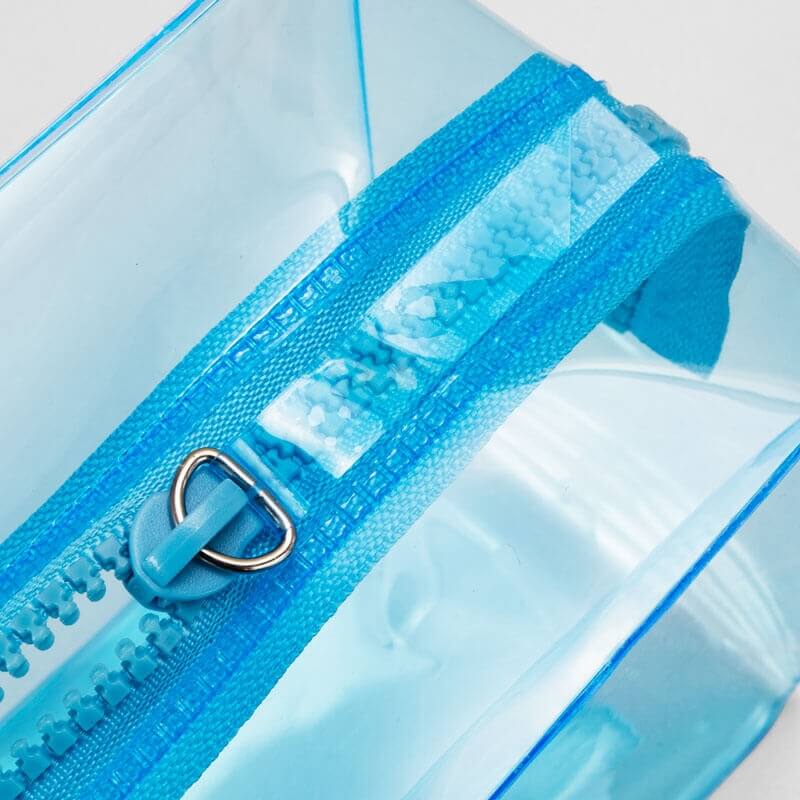
Check clarity, odor, seam, logo, zipper, insert card, barcode, carton mark, individual packing and pre-shipment photos or videos.
How to Prepare a Clear Cosmetic Pouch RFQ for Ecorivta
- Define the use case: Tell Ecorivta whether the pouch is for beauty GWP, travel retail, skincare minis, airport retail, PR kits or retail sale.
- Choose the material route: Compare PVC, EVA and TPU by transparency, softness, odor review, target price and market requirements.
- Prepare packing files: Send insert card, sleeve, barcode, carton mark and market version requirements before sampling.
- Confirm sample checks: Review clarity, smell, logo, seam, zipper, folded card and packing before bulk production.
- Send the RFQ to Ecorivta: Send target price, launch date, quantity, size, material preference and packing files to Ecorivta.
Send the brief to Ecorivta
The best RFQ is not a long message with every detail perfect. It is a clear first brief that tells Ecorivta the product use, target price, launch date, quantity, material direction, logo file status, packing idea and shipment requirement. Buyers can also use the Ecorivta contact route [5] when they want the team to review these details before sampling. With those details, the first reply can move from a rough price into a practical route.
| Check Sample and Packing Details Use this route when sample approval, packing files, barcode, carton mark, 3-1-1 size context or shipment evidence needs checking. |
Sources
- Use Ecorivta’s clear cosmetic pouch materials page as the main page for PVC, EVA and TPU route comparison: clear cosmetic pouch materials. Back to text
- Use the cosmetic bag page when the brief is broader than clear material and needs a softer cosmetic pouch route: cosmetic bag page. Back to text
- Use the Beauty GWP hub when the clear pouch is part of a broader gift set, launch kit or travel retail route: Beauty GWP hub. Back to text
- Use the TSA clear bags page only for true clear pouch demand and 3-1-1 context, not for approval language: TSA clear bags page. Back to text
- Use the contact route when buyers need material, packing, logo and size review before sampling: Ecorivta contact route. Back to text
- Use the TSA liquids rule as external 3-1-1 context without stating that a pouch is approved by TSA: TSA liquids rule. Back to text
- Use GS1 guidance when barcode or market label handoff affects retail packing: GS1 barcode guidance. Back to text
- Use the FTC Green Guides when environmental wording is requested for clear, recycled or alternative material routes: FTC Green Guides. Back to text
- Use OEKO-TEX STANDARD 100 as textile testing context where material safety questions matter: OEKO-TEX STANDARD 100. Back to text
- Use Sedex SMETA as an external reference when buyer programs ask for responsible sourcing review: Sedex SMETA audit guide. Back to text